Lisbon’s geographic character is defined by its verticality, a feature that has been romanticized since the 17th century through the legend of the "Seven Hills". This narrative, first popularized by Friar Nicolau de Oliveira in his Livro das Grandezas de Lisboa, was a deliberate attempt to equate the Portuguese capital with the grandeur of Rome. While modern geography identifies more than seven significant hills, the tradition persists, shaping the city's urban identity and its "soundscape"—the unique auditory dimension that characterizes its different quarters.
The Legend of the Seven Hills and Their Individual Identities
Each of the legendary hills—Castelo, São Vicente, Sant’Ana, Santo André, Chagas, Santa Catarina, and São Roque—possesses a distinct cultural signature. The highest point of this topography is the Hill of Santo André, home to the Graça district and the Miradouro da Senhora do Monte. This location offers a 250-degree panoramic view that serves as a chronological window into the city’s past. Historically, it was from this vantage point that King Afonso Henriques positioned his troops during the 1147 siege, making the hill the symbolic birthplace of the Portuguese nation.
The Mythology of the Adamastor and the Giant of Santa Catarina
The Miradouro de Santa Catarina is perhaps the most mythologically significant viewpoint in the city. It is centered around a monumental stone sculpture of the Adamastor, a creature invented by Luís de Camões in his epic poem Os Lusíadas. The Adamastor represents the "Cape of Storms" (later the Cape of Good Hope), manifesting as a vengeful giant who threatened the Portuguese fleets during the Age of Discovery. In modern Lisbon, the Adamastor has been recontextualized as a guardian of the sunset; the viewpoint is the primary social hub for the city's youth and street musicians, where the "soundscape" of acoustic guitars and communal dialogue overlooks the 25 de Abril Bridge.
Fado: The Auditory Soul of the Alleys
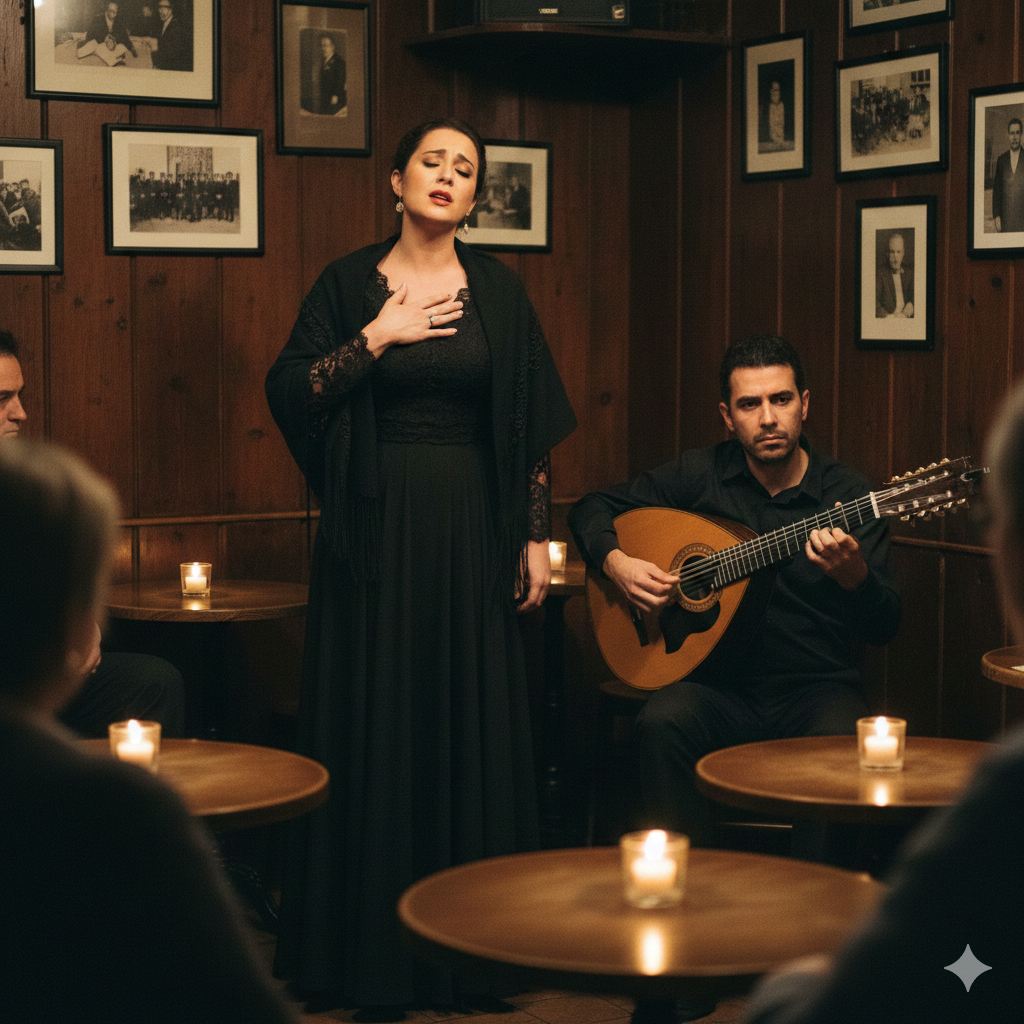
The transition from visual beauty to auditory experience is most evident in the sound of Fado. Recognized as UNESCO Intangible Cultural Heritage, Fado is the "Lisbon blues"—a melancholic musical form that emerged in the 1830s within the marginalized communities of Mouraria and Alfama. The genre is characterized by the concept of saudade, a term with no direct English translation that describes a mixture of nostalgia, longing, and resignation.
The historical evolution of Fado saw it move from the "half-door houses" and taverns of the poor into the aristocratic salons, eventually becoming a national symbol. Today, the "authentic" experience of Fado is found in the casas de fado of Alfama, where the performance typically consists of a singer (fadista) accompanied by a 12-string Portuguese guitar (guitarra portuguesa) and a classical guitar (viola). The auditory environment of these narrow streets, where voices echo off the stone walls, is considered an essential component of the musical experience, creating a "soundscape" that links the contemporary listener to centuries of maritime and urban struggle.