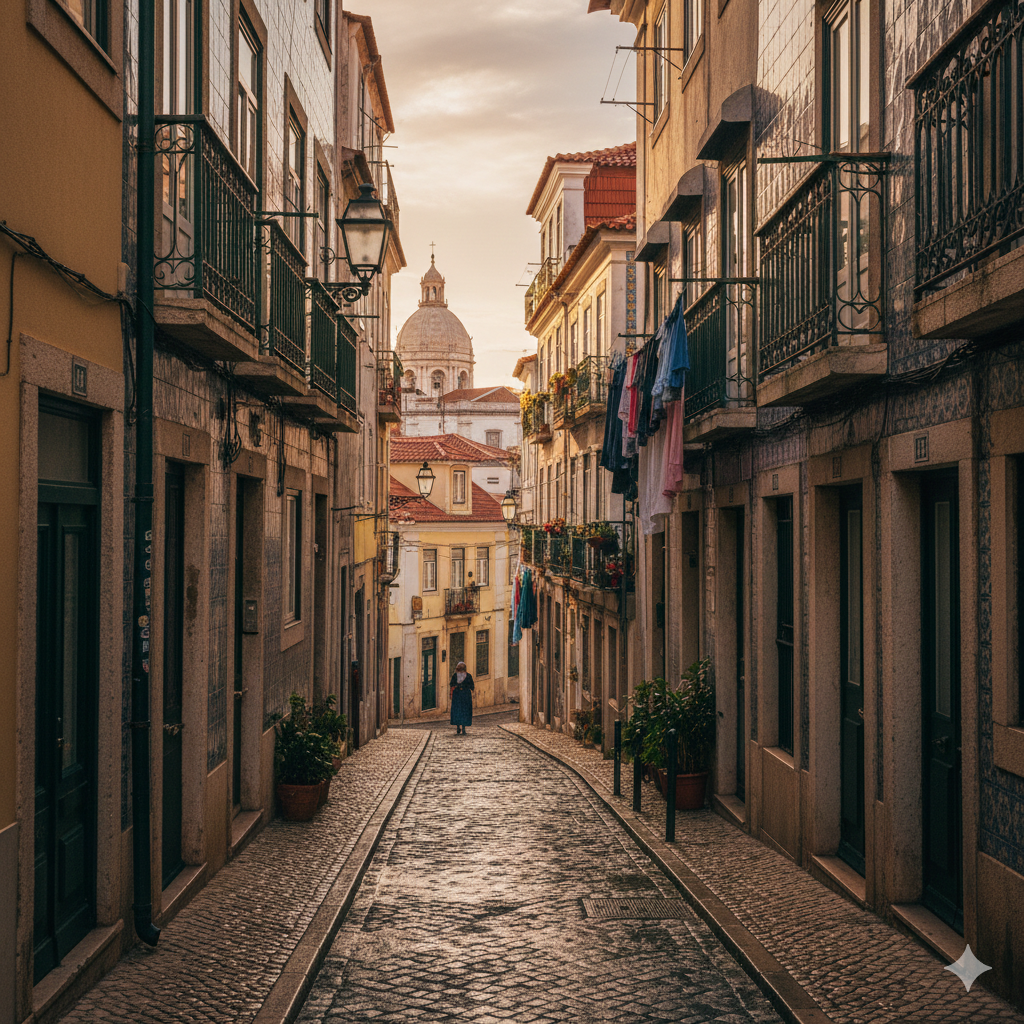
The urban identity of Lisbon is perhaps most poignantly expressed through the district of Alfama. As the oldest neighborhood in the capital, Alfama serves as a primary case study for urban resilience, having largely withstood the cataclysmic earthquake of 1755. To understand the contemporary layout of these winding streets, one must look to the layers of civilization that have occupied the hillside between the Tagus River and the Castelo de São Jorge. The name "Alfama" itself acts as an etymological bridge to the Islamic period, derived from the Arabic Al-hama, which translates to "hot springs" or "good water," referencing the geothermal activity once prevalent in the area.
The Moorish Urban Blueprint and Defensive Aesthetics
The physical structure of Alfama remains the most significant legacy of the Moorish occupation of the Iberian Peninsula. The neighborhood was designed as a defensive labyrinth, where narrow alleys and sudden, sharp turns were intended to confuse invaders and provide internal security. Beyond military strategy, this architectural style served a crucial bioclimatic function; the extreme narrowness of the streets ensures that the sun rarely reaches the pavement, creating a natural cooling system that facilitates air circulation during the Mediterranean summer. The aesthetic of the "hidden courtyard" or pátio is central to this design, offering private communal spaces away from the public eye, a concept that continues to define the social life of the bairristas today.
The 1755 Catastrophe and the Survival of the Hillside
The defining moment for Lisbon’s topography was the earthquake of November 1, 1755. While the lower Baixa district was decimated by the tremor, the subsequent fires, and the tsunami, Alfama was saved by its geological placement. Built on a solid limestone bedrock, the neighborhood absorbed the seismic waves more effectively than the alluvial soils of the valley floor. This survival created a unique urban paradox: the core of the city represents the "Enlightenment" ideals of the Marquis of Pombal—characterized by wide, rectangular avenues—while Alfama remains a medieval anomaly. This preservation is the reason the district retains its UNESCO-recognized authenticity, as it did not require the extensive rebuilding that transformed the rest of the city into a modern European capital.
The Transition from Aristocracy to Proletariat Enclave
Following the Christian Reconquest led by King Afonso Henriques in 1147, Alfama initially served as a prestigious residential area for the nobility and the ecclesiastical elite. However, as the city expanded westward and the Port of Lisbon grew in importance, the socioeconomic profile of the district shifted. By the 16th century, the nobility migrated toward the flatter lands of Belém and the emerging palaces of the Bairro Alto. Alfama subsequently became the domain of the maritime proletariat—sailors, dockworkers, and fishermen. This working-class identity is essential to the district's history, as it fostered the close-knit community structures and cultural expressions, such as Fado, that are now sought after by global travelers.