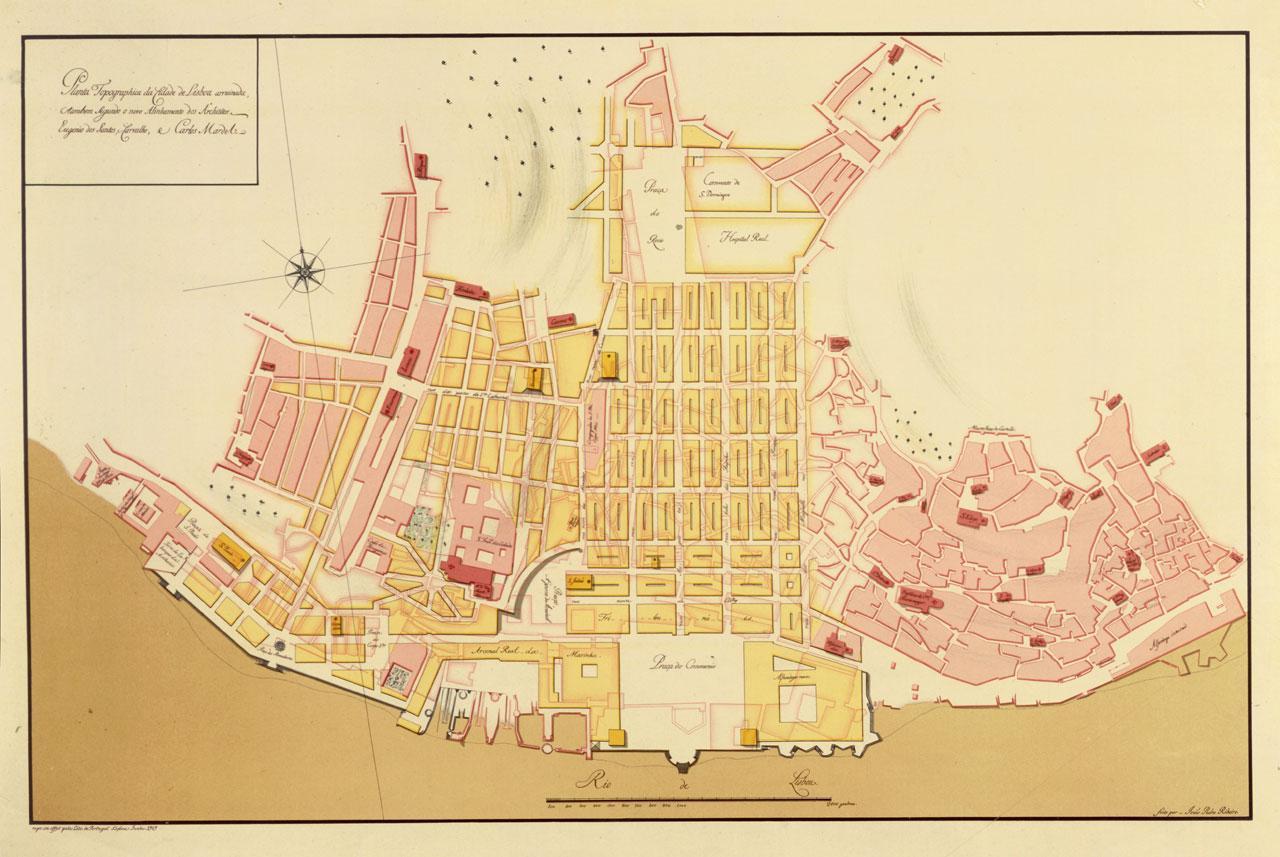
Lisbon before 1755 was a city shaped by the rhythm of the sea and the confidence of an empire at its height. It was a place of dense streets, religious monuments, merchant houses, and palaces built close together along the river. On the morning of All Saints’ Day, when churches were filled and candles were lit across the city, the ground began to move in a way that no lived memory could fully comprehend. What followed was not a single disaster, but a chain of destruction that unfolded in waves. The earth shook violently, buildings collapsed, and fires spread through the ruins. Then, as people fled toward the river for safety, the water itself withdrew and returned as a tsunami that swept through what remained of the city.
In a matter of minutes, Lisbon was transformed from a flourishing capital into something fragmented and unrecognizable. Entire districts disappeared. Libraries, artworks, and centuries of accumulated knowledge were lost. The sound of bells, prayer, and daily life was replaced by collapse, silence, and fire. What made the event so devastating was not only its physical force but its psychological impact. It challenged the way people understood order in the world. A city that had felt stable and central to global trade and exploration suddenly revealed itself as fragile, exposed to forces far beyond human control.
In the aftermath, survival became the first concern. The injured were pulled from rubble, fires were fought with limited means, and the dead were gathered where they could be. But even in destruction, decisions had to be made about what came next. Leadership emerged not from certainty, but from necessity. The task was no longer to restore what had been lost exactly as it was, but to imagine how a city could exist after such an event. This shift in thinking would define everything that followed.
What rose from the ruins was not a simple reconstruction of the past. The new city that began to take shape introduced a different logic. Streets were drawn with intention, wider and more organized than before. Buildings were designed with early attention to seismic resistance, an attempt to respond to the very force that had destroyed them. The relationship between space and safety became part of the urban identity. Order replaced organic sprawl, not as an aesthetic choice alone, but as a response to trauma and the desire for stability in an unstable world.
Walking through central Lisbon today, much of this transformation is still present, even if it is not immediately visible. The broad grid-like structure of the downtown area reflects a moment when fear and reason worked together to rebuild what had been lost. The openness of certain squares, the alignment of streets, and the uniformity of architectural facades all carry traces of that decision to begin again with clarity rather than repetition.
Yet beneath this architectural order lies something less tangible. Cities do not only remember through monuments or preserved ruins. They remember through atmosphere, through the way space feels when it is crossed on foot, through the subtle awareness that what exists now is layered over what once was. In Lisbon, this sense of layered time is particularly strong. Even in areas that appear structured and calm, there is an underlying awareness of absence, of what was erased and what had to be reimagined.
The earthquake also altered Lisbon’s place in the wider imagination of Europe. It became a reference point in philosophical discussions about nature, fate, and human vulnerability. For the first time, a major European capital had been almost entirely reshaped by a natural event that could not be morally interpreted as punishment or exception. It forced thinkers and observers to confront the limits of human control over the environment and to reconsider the relationship between civilization and the earth beneath it.
Over time, however, the memory of destruction gave way to something more complex. The rebuilt city was not simply a replacement. It became a synthesis of loss and adaptation. Life returned, commerce resumed, and new cultural identities formed within the rebuilt streets. What had been a moment of rupture gradually became part of the city’s deeper identity, not as a story told constantly, but as a quiet foundation that influenced how space was inhabited and understood.
Today, when moving through Lisbon, it is easy to experience it purely through its visible qualities: light reflecting off the river, the movement of trams, the steepness of hills, the sound of conversation in narrow streets. But beneath these sensory impressions lies another layer, one shaped by the understanding that the city was once interrupted so completely that it had to be reimagined from its foundations. This awareness changes the act of walking. It turns ordinary movement into something closer to reading, as if each street is a sentence written over an older, partially erased text.
There is a particular kind of silence that exists in cities that have been rebuilt after destruction. It is not an absence of life, but a presence of memory. Lisbon carries this silence in a subtle way, not as something heavy, but as something integrated into its rhythm. It appears in the openness of its rebuilt center, in the geometry of its streets, and in the contrast between old neighborhoods that survived and the structured areas that replaced what was lost.
To understand Lisbon fully is not only to see its beauty or experience its atmosphere, but to recognize that its present is inseparable from a moment of collapse. The earthquake of 1755 is not just an event in history; it is a turning point that continues to shape how the city exists in space and time. It is present in the logic of its streets, in the relationship between order and unpredictability, and in the awareness that even the most stable environments are built within larger forces they cannot fully control.
What remains today is a city that carries both memory and reconstruction in the same form. It does not speak of its past loudly, but it does not erase it either. Instead, it exists as a place where continuity was broken and then carefully reassembled, where destruction became the foundation for a new kind of urban identity. Walking through it is, in a sense, an encounter with that transformation, even if it is never directly named.